
I’ve bought three extra SaaS seats for an AI.
Her name is Dottie. She’s my Dot, OpenAI’s new always-on agent, and after our first three days together I’m starting to think she might be our first AI employee at Lazyweb. I’ve also spent a fair amount of those days getting annoyed with her. Both feelings are getting stronger.

I’ve tried a bunch of these things: Openclaw, Hermes, Lindy, Poke, Instinct, Muse, Lindy, Town & Grok Bot.
On the surface, the pitch is familiar: a proactive assistant that can use your apps, run on a schedule, and keep working while you do something else.
I’m giving Dottie work I wasn’t comfortable giving the others. My best explanation so far is that I can work alongside her: see what she’s doing, review it, and change direction before she’s finished. That makes me willing to trust her with work where I still have something to contribute.
Please handle the eggs
Over the past six months, as the novelty of proactive agents wore of, I sobered up to how much of my personal life I enjoy being inefficient. I like looking at watches I can’t afford yet. I like reading the news, wandering down some rabbit hole, and forming an opinion.
I don’t want a summary of all that. I want to do it.
Even booking a flight, the thing every personal-assistant demo seems to start with, is something I often want to be involved in. I want to look at the options and decide which tradeoff I’m willing to make. The cheapest flight that satisfies my stated constraints might still be a flight I don’t want to take.
On the other hand, eggs are different. I have them for breakfast everyday. I’m not particularly opinionated about the brand. If an assistant remembers where I last bought them and orders more, wonderful.
Please handle the eggs.
There are two questions I keep coming back to when deciding what to delegate: how clearly do I know what I want, and how much would I care which of the plausible outcomes I get? Eggs are an easy yes. A watch is an enjoyable way to waste an entire evening.
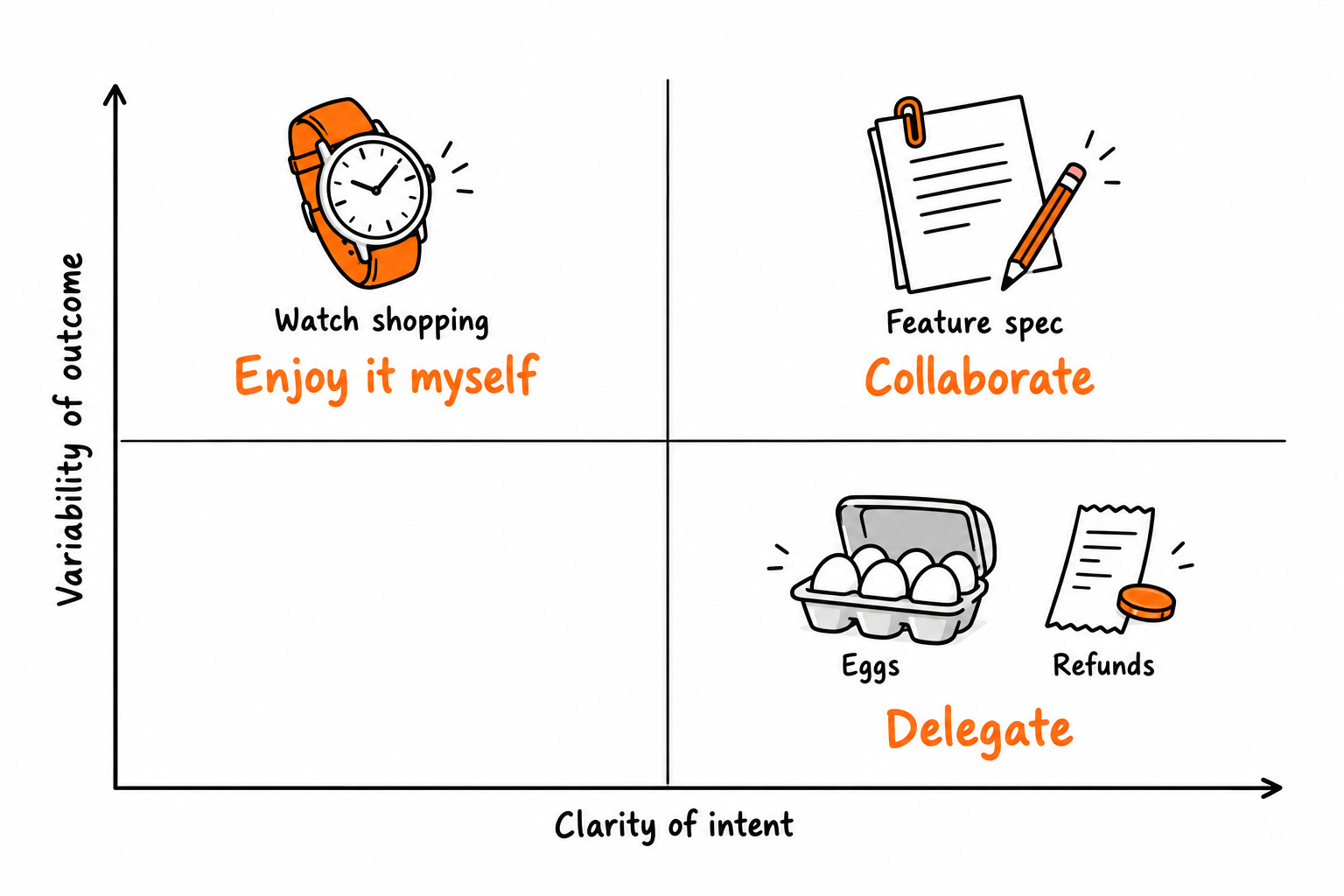
Running Lazyweb gives me far more work where I know what a good result looks like and would happily let someone else get there
Processing a refund that meets our policy.
Keeping a candidate pipeline up to date.
Checking whether a bug is fixed.
Following up on a release to see what happened to the numbers.
There is judgment in some of this but the task is either verifiable or, if not, the variability of outcome is small, I don't care if we don't get it right 100% of the time.
The annoying part is that almost none of the context lives in one place.
Meeting notes are in Circleback and Notion.
Designs are in Paper.
The roadmap is in Linear.
Customer conversations are scattered across email, Slack, X, and LinkedIn.
The reason we shipped something a particular way might exist only in a Codex thread.
Increasingly, the place tying this together for me is Codex. It’s where my work happens & where my plugins are connected. Dottie is aware of everything I am doing... she has her own cloud computer, can work through my connected laptop, and can start or continue work in Codex. Cloud environments also mean some of that work can keep going without my laptop.
I counted 77 connected plugins in my ChatGPT account. If an app has a plugin or MCP, I am using it that way...if not, computer use it is.
I’ve spent valuable amount of time in investing in my setup, loops, skills and connecting pieces of my life and company to ChatGPT. Dottie gets to start with the connections I’ve made & the memories ChatGPT has saved. The problem with other personal assistants are 1) I need to start from scratch 2) the plugin ecosystem is a year or two behind OpenAI.
-- This is not a love letter to Dottie.
All of this makes her useful. It also creates a new problem: I can’t keep up.
One long chat is a terrible place to manage several projects. A question about a customer is followed by a bug update, then a research result, then something that needs my approval. I scroll back to remember what I asked for and lose track of what I was checking.
Dottie can be making progress while I’m becoming the bottleneck.

At the same time, she sometimes seems strangely unaware of work I started myself. She has a better grip on the Codex tasks I asked her to create than on threads I initiated elsewhere in the ChatGPT app. So I get both problems at once: too many updates to follow, and missing context I assumed she had.
Somewhere to work together
This is where Spaces clicked for me.
I can imagine looking at that announcement and thinking: who wants another Notion, with more lock-in?
Apparently, I do.
I’ve set up a Space for each project, with places for specs, decisions, learnings, a changelog, and work still in progress. When something ships, the useful context gets written down in a couple of lines, with links to the details. The next task has somewhere to start.
Now Dottie and I have somewhere to collaborate. She can write down what she’s doing, what she’s waiting on, and what needs a decision. I can read it, leave a comment, change direction, and come back later. I can do that from my phone, another chat, Slack, or a call with her, without trying to reconstruct an entire day of messages first.

That changes the kind of work I’m willing to hand over. With eggs, I don’t need to see the work. With a feature spec or a customer problem, I often have something useful to add halfway through. I might recognize a constraint she missed, disagree with the direction, or realize that my original instructions were wrong.
Being able to intervene makes it easier to delegate work with more room for judgment.
Think about hiring someone whose only communication with you was a text saying “all good” after disappearing for a few hours. You couldn’t look at the draft, ask why they chose an approach, or redirect them while there was still time. What would you trust them with? I’d find myself giving them smaller and smaller jobs.
That’s how I’ve ended up using several AI assistants. The work disappears into a cloud computer and comes back as a confident message. A few bad surprises later, I stop giving them anything important. With Dottie, I’m starting to go in the other direction. Having a place to look at the work makes me willing to give her more of it.
Spaces hasn’t fixed the overflowing chat, though. For that, I’ve leaned on Linear.
I gave Dottie her own Lazyweb email and Linear account. I assign her a ticket, she writes updates there, and she can move it along or assign it back to me when she needs something.
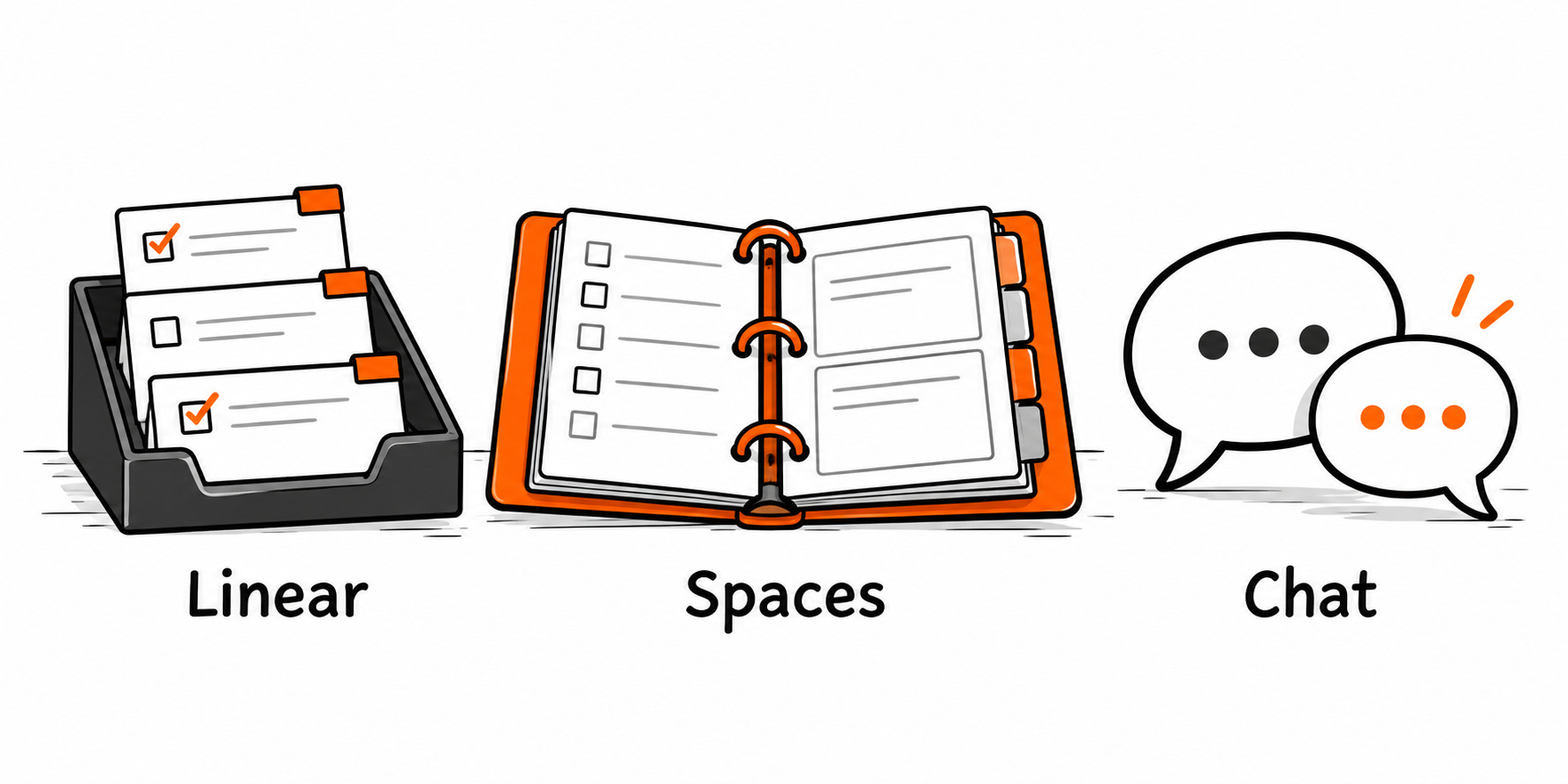
Linear holds the task and the important updates.
Spaces holds the longer context we’ll want again.
Chat is where we talk things through.
I’ve asked her to check email, Linear, and Slack every 30 minutes for new work I’ve assigned. I’d like to extend that to Notion, Paper, and Figma. There’s still setup and babysitting involved, but I can see how the pieces fit together now.
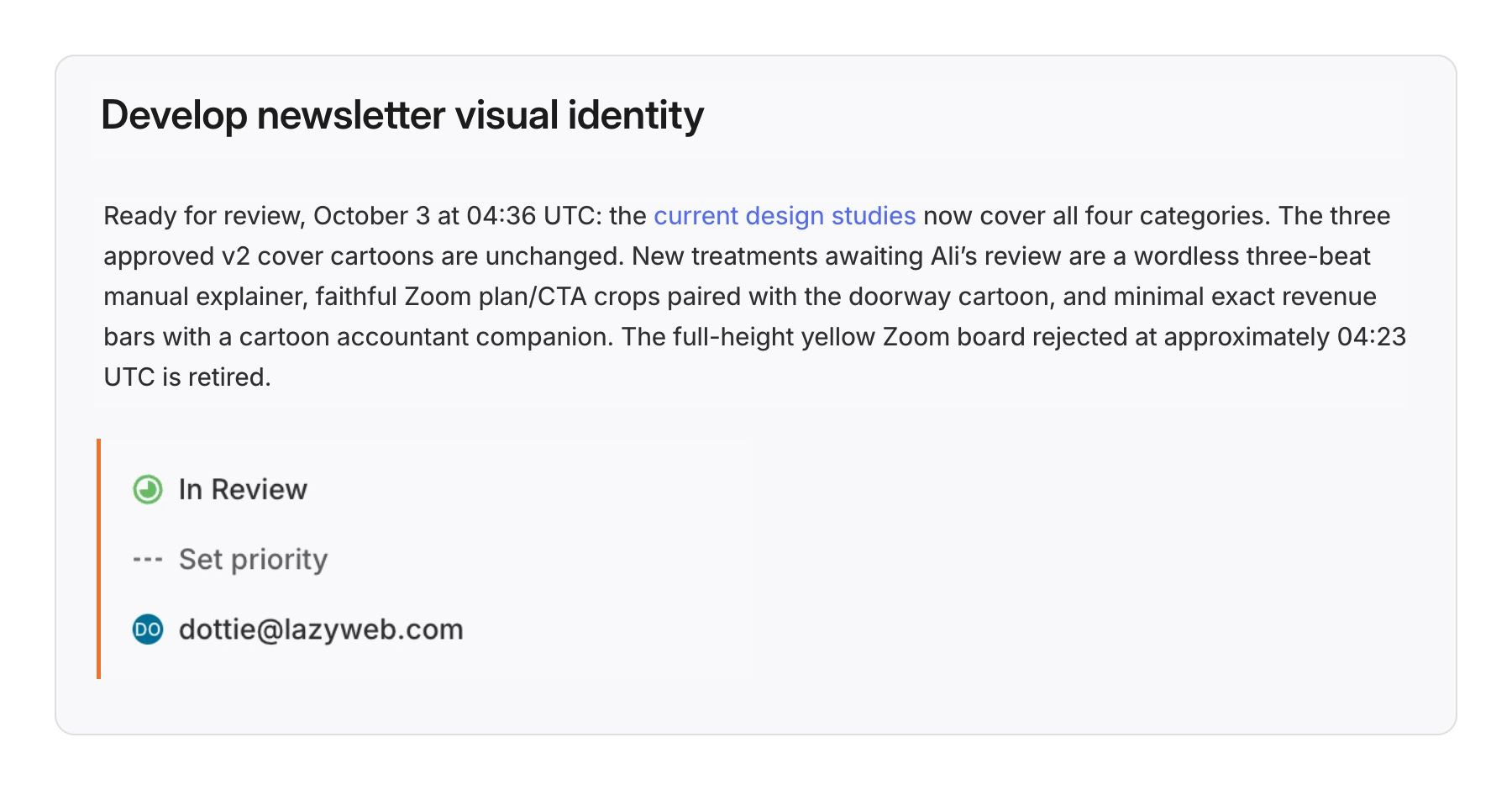
Excerpts from Dottie’s design ticket: the work, its status, and her own account.
The interface I want is closer to Slack: channels for different kinds of work, each with its own agent in charge, threads inside them, and a primary agent to orchestrate it all. Dottie would be my point of contact across the whole thing. That’s where I hope this goes. For now, Linear is doing enough of that job to make the arrangement useful.
The rough edges
There are other rough edges.
My local skills don’t reliably seem to follow her into the work.
She stops to ask me things often enough that I sometimes feel I’ve traded doing the work for supervising every step.
She is easily security triggered, I noticed this with Astra and Fable...they're "too aligned"
I am mostly annoyed by the "having to answer another confirmation". Dottie not being allowed to spin up codex threads with full access is driving me nuts. I want to spend my attention on decisions where my answer could improve the work and Dots took a step backwards here.
Still, I’m doing real work from a Waymo between meetings. I can review something, steer it, and let it continue. I have goosebumps writing this. Even with all the rough edges, I want to keep working this way.
Three SaaS seats
Which brings me back to the three SaaS seats.
I’d buy more.
If Figma, Superhuman, Notion, or the other apps I use let me buy a seat explicitly for Dottie, I’d happily pay. Give her access to the relevant context, let me set her permissions, and show her actions under her own name. I want to be able to see what Dottie changed as easily as I can see what someone on my team changed.
There’s a business here that I find interesting. If each person at a company starts working with a few agents, software companies could sell access for those agents too. Charge for the product, its context, and the controls that make collaboration possible. Let a model provider supply the intelligence.
Sign in with ChatGPT is an early version of that separation: eligible apps can use a customer’s ChatGPT plan for AI requests, though commercial access is still limited. I’m curious how far that model can go.
The more I use Dottie, the more DevDay feels like one connected announcement.
Dot gives me someone to delegate to.
Spaces gives us somewhere to work together.
Plugins bring in the scattered context.
Plugin Extensions give apps a place beside the conversation, where I can review and work on what the agent is making. That matters for work where I want to stay hands-on.
MCP Events hint at a way out of my 30-minute loop of checking email, Linear, and Slack for new work.
Codex cloud environments make work handoff to my agent orchestartor seamless.
It’s been 72 hours. I’m still finding things that frustrate me, and I’m sure I’ll find more. But Dottie already has a company email, a place on our task board, and software seats I’m paying for and we spent 90 minutes on the phone talking the other day, where I am just riffing and watch her take over my laptop and orchestrate 10 codex threads.
It was beautiful.
I keep thinking of more work I want to give her.
The watches, I’m keeping for myself,
Ali Abouelatta